




How Much Does a Walk-In Shower Cost in Illinois? (2026 Pricing Guide)
On This Page Introduction Conclusion Related Services Frequently Asked Questions Ready to Transform Your Bathroom? Schedule Your Free In-Home Estimate Today Free In-Home Estimate
Most home safety conversations focus on stairs, throw rugs, or outdoor walkways. Those hazards are real, but the bathroom is where the injury risk is most concentrated. A person steps over a tub wall, loses their footing on a wet surface, grabs for something that isn’t there — and a routine morning routine becomes an emergency room visit.
The financial and human cost of bathroom falls is staggering. Hip fractures, the most common serious fall injury in older adults, often require surgery, extended rehabilitation, and in many cases permanently reduce a person’s ability to live independently. Preventing a single fall can mean the difference between staying in your own home and moving into assisted living years earlier than you planned.
The upgrades below aren’t about making a bathroom look medical or institutional. Done right, they make a bathroom more comfortable and functional for everyone in the house — while dramatically reducing the risk of a life-altering injury.
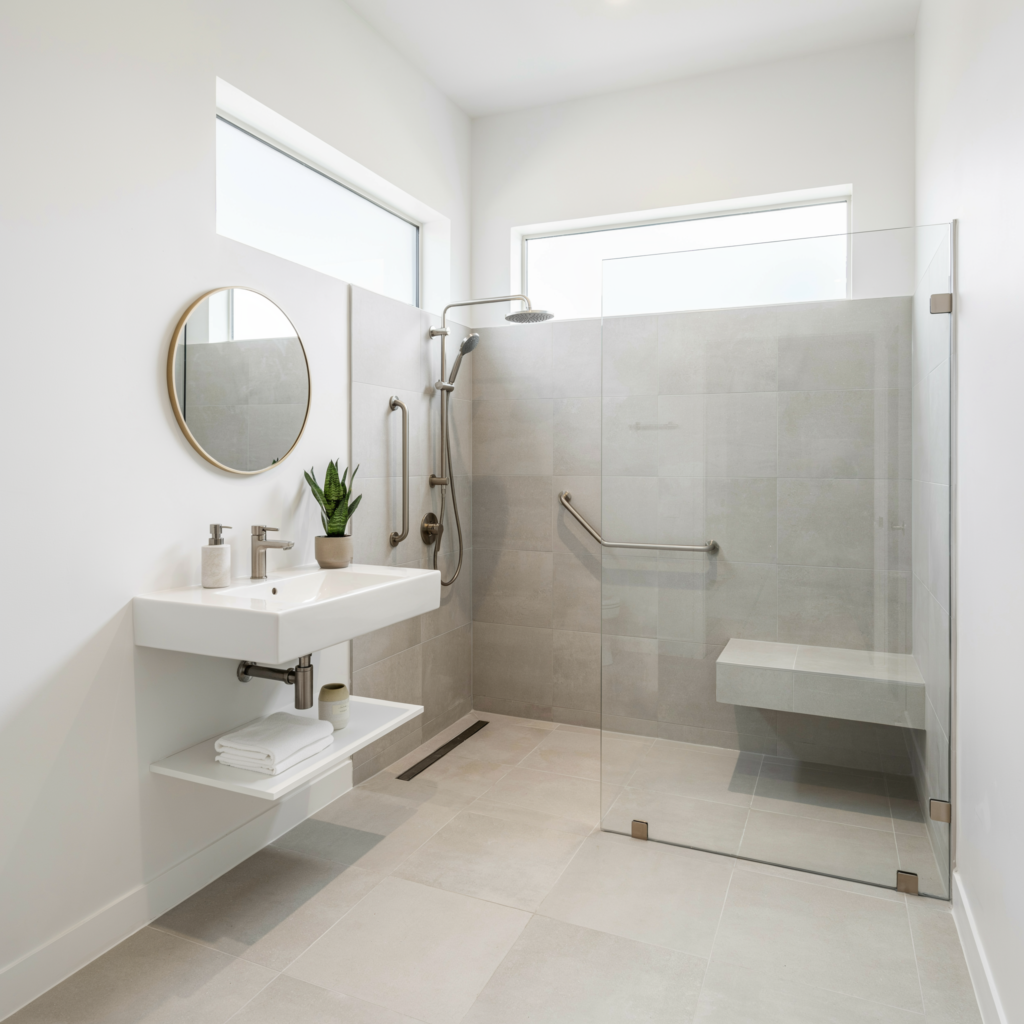
Grab bars are the foundation of any serious bathroom safety plan. Placed correctly — at the entry point of the shower or tub, along the shower wall, and next to the toilet — they give seniors something solid to hold onto during the moments of greatest instability. Getting in and out of the shower, lowering yourself onto the toilet, standing up from a seated position: these are when falls happen.
The key word is correctly. Grab bars need to be anchored into wall studs or blocking, not just drywall. A bar screwed into drywall alone will pull out under load, which is exactly when a person needs it most. A professional installation ensures bars are placed at the right height and angle for the individual user and secured to framing that will hold.
Modern grab bars don’t look institutional. Many designs integrate smoothly with contemporary bathroom finishes — brushed nickel, matte black, chrome — so they blend into the space rather than announcing themselves as medical equipment. Function and aesthetics don’t have to be opposites.
One of the most impactful bathroom safety upgrades for seniors is replacing a traditional shower pan or tub with a curbless, zero-threshold shower. That raised lip at the bottom of most showers — even a four-inch one — is a tripping hazard every single time a person steps in or out. Wet feet, dim lighting, and a moment of inattention are all it takes.
A curbless shower removes that obstacle entirely. The floor transitions smoothly from the bathroom into the shower, with a slight slope toward the drain to manage water. This design is safer, easier to clean, and also happens to look clean and modern. It’s a win across the board.
For homeowners using a walker or wheelchair, or anticipating that need in the future, a curbless shower isn’t optional — it’s essential. But even for seniors who are fully mobile today, eliminating the step is a proactive decision that pays off over time.
A standard bathtub requires stepping over a wall that’s typically 14 to 18 inches high, then lowering yourself to the floor of the tub, and then getting back up from a seated position with wet, slippery surfaces all around. For a younger person in good health, it’s manageable. For someone with reduced strength, balance issues, or joint pain, it’s genuinely dangerous.
A tub-to-shower conversion replaces the existing bathtub with a walk-in shower — ideally curbless — that’s far easier to use safely. The result is a bathroom that fits the way the homeowner actually lives, rather than a space designed for a younger version of themselves. Many seniors find they stopped using the tub years ago anyway, making this a practical upgrade with clear safety benefits.
EZ Bath N Shower handles tub-to-shower conversions throughout Lake and McHenry County, typically completing the project in one to two days with minimal disruption to the household.
Grab bars and curbless showers do a lot, but if the floor surface itself is slick when wet, the risk remains. Smooth porcelain tile — the most common bathroom flooring — becomes dangerously slippery when wet. This applies to both the shower floor and the main bathroom floor.
Textured tile with a high slip-resistance rating (look for a DCOF rating above 0.42 for wet areas) provides meaningful traction underfoot. Smaller tiles with more grout lines also increase grip. For the area outside the shower, a quality bath mat with a non-slip backing adds another layer of protection — but it’s not a substitute for a safer floor surface.
When remodeling, this is the time to choose flooring with safety built in. Retrofitting an existing floor is harder, but even applying a non-slip coating or adding strategically placed mats reduces risk meaningfully.
A fixed showerhead forces a person to move around under the spray, which means shifting weight, reaching, and twisting — all movements that challenge balance. A handheld showerhead on a sliding bar changes the equation entirely. The bather can direct the water where it needs to go rather than moving their body to meet it.
Handheld showerheads are also essential for anyone who bathes seated on a shower bench or transfer bench. They make it possible to rinse thoroughly without standing at all. The sliding bar means the height adjusts to suit the user on any given day, standing or seated.
This is one of the least expensive upgrades on this list and one of the most immediately useful. It’s also the kind of thing that benefits everyone in the household, not just seniors.
Standard toilets sit at about 15 inches from floor to seat. Comfort height toilets — sometimes called ADA-compliant toilets — sit at 17 to 19 inches, roughly the height of a standard chair. That extra two to four inches makes a significant difference for people with knee pain, hip replacements, or reduced leg strength.
Lowering yourself onto a very low seat and then pushing yourself back up requires significant quad strength and balance. A higher seat reduces the range of motion required and makes the entire process safer and less physically demanding. Paired with a grab bar on the adjacent wall, the toilet area becomes much more manageable for seniors with limited mobility.
Toilet safety frames and raised toilet seats are temporary alternatives, but a comfort height toilet is a permanent, clean solution that integrates into the bathroom without looking like adaptive equipment.
Poor lighting is an underrated hazard. Many older bathrooms rely on a single overhead fixture that casts shadows in exactly the wrong places — near the floor, inside the shower, around the toilet area. As vision changes with age, these shadows become harder to compensate for.
Brighter, more evenly distributed lighting reduces the chances of misjudging a step or failing to see a wet spot on the floor. The National Institute on Aging recommends improving lighting throughout the home as a core falls prevention strategy, and the bathroom is the highest-priority room. Night lights or motion-activated lighting are also worth adding for anyone who gets up during the night.
LED lighting upgrades are inexpensive, long-lasting, and dramatically improve visibility. This is one area where a simple fix genuinely matters.
A built-in shower bench or fold-down seat gives seniors the option to sit while showering — reducing fatigue, improving safety, and extending the amount of time a person can bathe independently. Standing for an entire shower is harder than most people realize until it isn’t, and having the option to sit changes what’s possible.
Built-in teak benches and tiled bench seats look intentional and attractive, not medical. Fold-down seats save space in smaller showers and fold flat when not needed. Either option, installed during a shower remodel, adds very little to the overall project cost while providing substantial long-term value.
Every upgrade on this list costs money. That’s the honest reality. But the cost of a serious fall dwarfs the cost of prevention by orders of magnitude. The CDC estimates that fatal falls among older adults cost the U.S. healthcare system over $50 billion annually, with the average hospitalization for a fall-related injury running tens of thousands of dollars out of pocket even with insurance.
Beyond the financial cost, there’s the human cost. A hip fracture changes lives. Recovery is long, painful, and often incomplete. Many seniors who suffer a serious fall never fully regain the independence they had before. The upgrades in this guide exist to prevent that outcome — not just to make a bathroom look nicer.
Investing in bathroom safety upgrades for seniors now is genuinely less expensive than a single emergency room visit. For most homeowners, that math is very easy.
On This Page Introduction Conclusion Related Services Frequently Asked Questions Ready to Transform Your Bathroom? Schedule Your Free In-Home Estimate Today Free In-Home Estimate

On This Page Introduction Conclusion Related Services Frequently Asked Questions Ready to Transform Your Bathroom? Schedule Your Free In-Home Estimate Today Free In-Home Estimate

On This Page Introduction Conclusion Related Services Frequently Asked Questions Ready to Transform Your Bathroom? Schedule Your Free In-Home Estimate Today Free In-Home Estimate