



How Much Does a Walk-In Shower Cost in Illinois? (2026 Pricing Guide)
On This Page Introduction Conclusion Related Services Frequently Asked Questions Ready to Transform Your Bathroom? Schedule Your Free In-Home Estimate Today Free In-Home Estimate
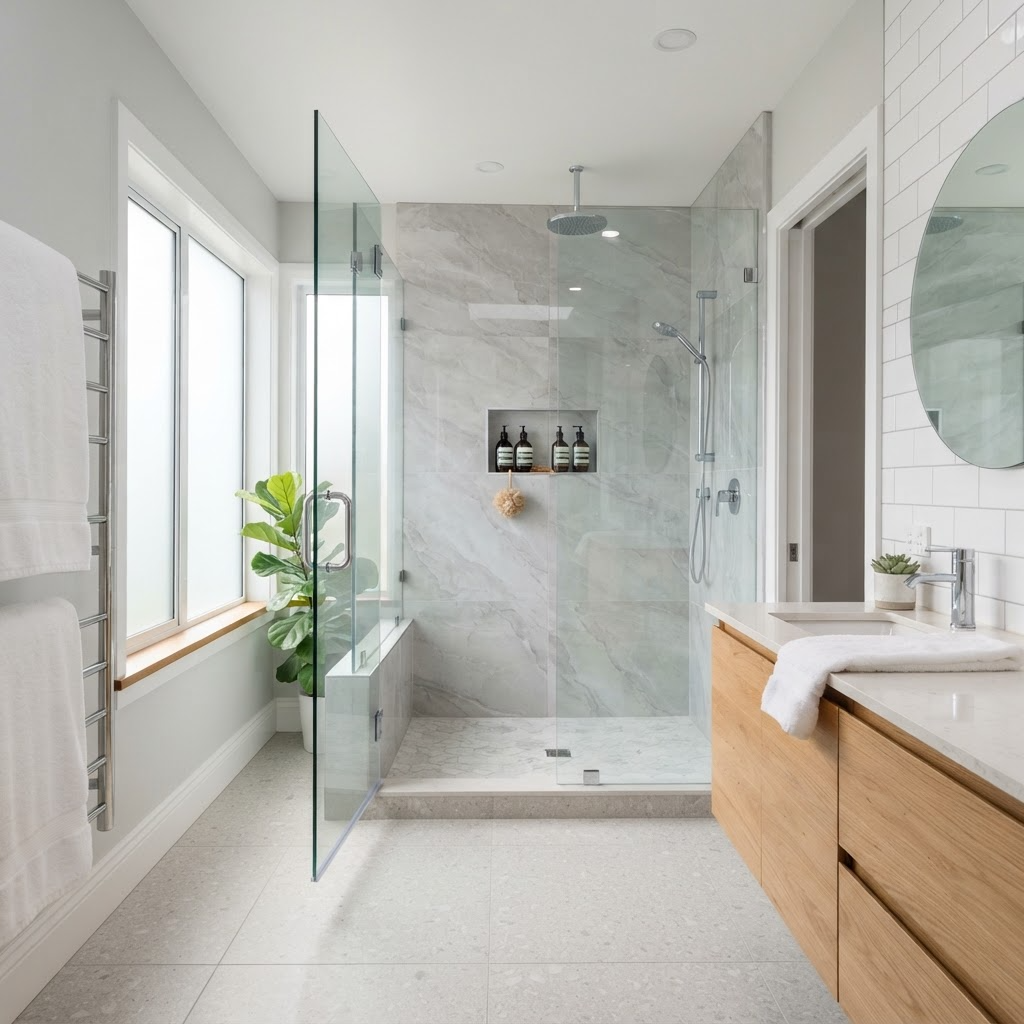
A tub-to-shower conversion removes an existing bathtub and replaces that footprint with a walk-in shower. Depending on the project, this can include new plumbing rough-in, a custom or prefabricated shower base, new wall surrounds or tile, updated fixtures, glass doors or a frameless enclosure, and updated lighting or ventilation.
Some conversions are straightforward — pulling a standard alcove tub and dropping in a prefab shower unit. Others involve full tile work, bench seating, niche shelving, and barrier-free entry for accessibility. The scope drives the cost and the timeline, but even complex projects are typically completed in two to four days by an experienced crew.
The key distinction from a simple tub replacement is that you’re changing the function of the space entirely. You’re not just swapping one fixture for another — you’re redesigning how the bathroom works on a daily basis.
To see how these options could fit your home, explore our tub-to-shower conversions in McHenry County and discuss your layout, materials, and project scope with our team.
Standard bathtubs occupy roughly 13 to 15 square feet of floor space. A well-designed walk-in shower can serve the same bathing purpose in as little as 9 square feet — and visually, an open shower with glass panels makes a bathroom feel significantly larger than it actually is.
In older homes throughout Grayslake, Round Lake, and Wauconda, bathrooms were often built compact. A tub that made sense in 1975 can feel oppressive in a bathroom that also needs to accommodate two adults. Converting to a shower reclaims usable floor space, improves flow, and often creates room for storage features that simply didn’t fit before.
This is one of the most consistent findings in bathroom remodeling research. The National Kitchen and Bath Association regularly tracks design trends, and walk-in showers have ranked among the most requested bathroom features for several years running — driven largely by homeowners prioritizing function over tradition.
Here’s a factor that doesn’t get enough attention in these conversations: safety. Climbing in and out of a bathtub is one of the leading causes of bathroom falls, particularly for adults over 60. The CDC reports that about 235,000 people visit emergency rooms each year due to bathroom injuries, with tubs and showers accounting for the majority of those incidents.
A walk-in shower — especially one with a zero-threshold entry, grab bars, and a built-in bench — dramatically reduces that risk. For empty nesters or homeowners approaching retirement age, this isn’t just a convenience upgrade. It’s a decision that supports staying in the home longer and living more independently.
Aging-in-place remodeling has become one of the fastest-growing segments of the residential renovation market. If you’re planning to stay in your Lake County home for another decade or more, building accessibility into the bathroom now is far less disruptive than doing it in an emergency later.
This is the concern that stops most homeowners cold: will I lose resale value if I remove the only bathtub in my home? The short answer is yes — if it’s the only full bathroom in the house. Real estate professionals and appraisers widely agree that a home with no bathtub at all is harder to sell and appraises lower, particularly to buyers with young children.
But context matters enormously. If your home has two full bathrooms and you’re converting the tub in one of them, the impact on resale is minimal. Buyers expect at least one tub in the home, but most don’t need two. Converting a secondary bathroom to a shower-only space is a common and well-accepted upgrade.
According to data compiled by HomeAdvisor’s bathroom remodeling research, a mid-range bathroom remodel that includes a tub-to-shower conversion returns roughly 60 to 67 percent of its cost at resale on average. That’s not a full return, but it’s also not a loss — especially when you factor in the years of daily use you get from the upgrade.
The National Association of Realtors has noted in its Remodeling Impact Reports that bathroom renovations consistently rank among the top projects for homeowner satisfaction, even when the direct dollar-for-dollar ROI doesn’t hit 100 percent. Enjoyment of the space has real value.
Not every homeowner is the right candidate for a tub-to-shower conversion. Here’s a clear breakdown of who typically benefits most:
On the other hand, if your home has only one bathroom and you regularly have young children or plan to, keeping a tub is worth serious consideration. And if you personally love baths and use your tub regularly, there’s no reason to convert just because it’s trendy.
Cost ranges vary based on the type of conversion. A basic prefab shower insert installed in an existing tub alcove can run $1,500 to $3,000 installed. A custom tile shower with a frameless glass enclosure, niche shelving, and upgraded fixtures runs $5,000 to $10,000 or more depending on materials and labor.
The ROI equation involves more than resale math. Consider what it costs you to not do it: a bathroom you avoid using, a fixture that feels dated every time you walk in, or a safety hazard you’re working around daily. Those hidden costs are real, even if they don’t show up on a spreadsheet.
For homeowners in the Chicagoland suburbs, the local market also plays a role. Lake County and McHenry County have strong demand from families and retirees alike. A well-executed bathroom renovation that addresses both function and aesthetics tends to hold its value well in this market.
The quality of the conversion depends almost entirely on who does the work. A poorly installed shower — bad waterproofing, improper slope on the drain, misaligned tile — creates moisture problems that cost far more to fix than the original project cost. This is not a job to hand to the cheapest bidder.
When hiring a contractor, ask about their experience specifically with tub-to-shower conversions, request references from similar projects, and make sure they’re licensed and insured in Illinois. The Houzz guide to hiring a contractor is a solid resource for understanding what questions to ask before signing anything.
Local contractors who specialize in bathroom remodeling — rather than general contractors who do everything — typically bring more focused expertise to these projects. They’ve solved the specific problems that come up in residential bathroom conversions and can anticipate issues before they become expensive surprises.
EZ Bath N Shower is a Grayslake-based bathroom remodeling company that works exclusively with residential homeowners throughout Lake and McHenry County. Every tub-to-shower conversion is handled by the company’s own crew — no subcontractors, no hand-offs, no surprises on the final invoice.
The team works on projects of all sizes, from straightforward alcove conversions to fully customized walk-in showers with accessibility features. Pricing is transparent from the start, and projects are designed to be completed quickly with minimal disruption to the household. For homeowners who’ve been putting this project off because they weren’t sure who to trust, that approach makes a real difference.
On This Page Introduction Conclusion Related Services Frequently Asked Questions Ready to Transform Your Bathroom? Schedule Your Free In-Home Estimate Today Free In-Home Estimate

On This Page Introduction Conclusion Related Services Frequently Asked Questions Ready to Transform Your Bathroom? Schedule Your Free In-Home Estimate Today Free In-Home Estimate

On This Page Introduction Conclusion Related Services Frequently Asked Questions Ready to Transform Your Bathroom? Schedule Your Free In-Home Estimate Today Free In-Home Estimate