



How Much Does a Walk-In Shower Cost in Illinois? (2026 Pricing Guide)
On This Page Introduction Conclusion Related Services Frequently Asked Questions Ready to Transform Your Bathroom? Schedule Your Free In-Home Estimate Today Free In-Home Estimate
Let’s start with the numbers. The National Association of Realtors consistently tracks what renovations deliver the strongest return on investment, and bathrooms rank near the top every cycle. According to NKBA research, bathroom remodels are among the top five projects homeowners undertake, with updated showers cited as one of the primary drivers of buyer interest. That’s not marketing — that’s purchase behavior data.
Zillow has reported that homes with certain luxury bathroom features, including frameless glass showers and walk-in designs, sell faster and closer to asking price than comparable homes without them. Faster sales at asking price is arguably a better outcome than a modest bump in appraised value — it puts real money in your pocket without months of carrying costs.
The caveat? The return depends heavily on what you’re replacing, what stays in the home, and who’s buying in your specific market. Lake County and McHenry County attract a wide mix of buyers — young families, move-up buyers, empty nesters — and each group weighs bathtubs and showers differently.
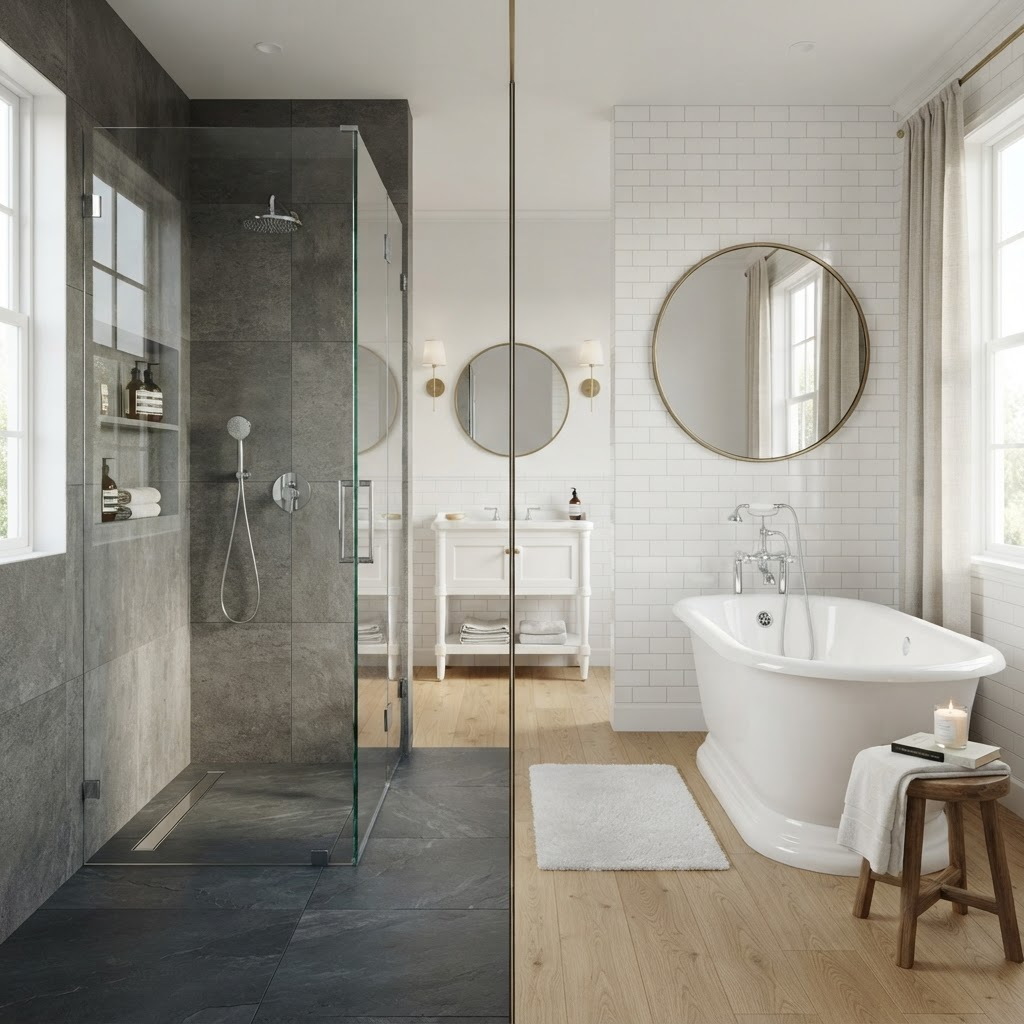
Walk-in showers have moved well past trend status. They’re a baseline expectation in any remodeled master bathroom. Open layouts feel cleaner, take up less visual space, and are dramatically easier to clean than a tub-shower combo. For most adults who shower daily and bathe rarely, the case for a walk-in shower is practical before it’s aesthetic.
From a resale standpoint, a well-executed walk-in shower signals that a bathroom has been thoughtfully updated. Buyers associate frameless glass enclosures, quality tile work, and bench seating with modern design — and modern design commands attention in competitive markets like Libertyville, Vernon Hills, Crystal Lake, and Woodstock.
A local cost breakdown from Angi for the Chicago area shows that walk-in shower installations in the region typically run between $3,500 and $10,000, depending on configuration. That investment, when executed correctly, can recoup 60–80% at resale in updated bathroom contexts — and that figure climbs when the shower replaces an outdated tub-shower combo that was dragging down the room’s appeal.
Here’s where many homeowners get into trouble. Removing every bathtub from a home to install walk-in showers is a move that real estate agents across the country consistently flag as a resale red flag — particularly for homes with two or three bedrooms where families are the most likely buyers.
The rule of thumb most agents follow: never remove the last tub in a home. Full stop. Young families with children depend on bathtubs. Buyers with young kids will often cross a home off their list the moment they realize there’s no tub anywhere in the house. According to Houzz’s annual renovation report, homes that retain at least one bathtub in a multi-bathroom layout consistently score higher in buyer preference surveys among households with children under 12.
The practical takeaway: if your home has two or more bathrooms, converting one tub to a walk-in shower is a savvy upgrade. Converting both — or the only tub — is a risk that rarely pays off in resale scenarios, particularly in suburban markets like those across Lake and McHenry County where family buyers make up a significant portion of demand.
Demographics drive bathroom decisions more than most homeowners realize. A walk-in shower is a near-perfect fit for empty nesters whose kids have moved out, single professionals, couples without children, and anyone prioritizing ease of access and daily convenience. The absence of a tub doesn’t register as a loss for these households — it registers as a win.
Families with young children have the opposite calculus. Bath time is a daily ritual, and a walk-in shower doesn’t substitute. For this group, a tub-to-shower conversion makes sense in the master bath only if there’s still a tub elsewhere in the home — usually a hall bath or secondary bath that serves the kids.
Aging-in-place is its own category entirely. For homeowners over 60, or those planning for long-term accessibility, a walk-in shower isn’t just preferable — it’s significantly safer. Eliminating the step-over threshold of a traditional tub reduces fall risk, which is the leading cause of injury-related hospitalizations for adults over 65. Zero-entry or curbless shower designs, grab bars, and bench seating turn a bathroom upgrade into a genuine safety investment.
For many Lake County and McHenry County homeowners, the smartest move isn’t choosing between a tub and a shower — it’s converting a rarely-used tub in the master bath into a walk-in shower while keeping the tub in a secondary bathroom intact. This approach lets you enjoy the daily comfort of a modern walk-in shower without sacrificing the resale appeal that a tub provides for family buyers.
According to HomeAdvisor’s tub-to-shower conversion cost guide, this type of project typically runs between $1,200 and $8,000, depending on the scope of work, drain relocation, and the finish materials selected. That’s a meaningful upgrade for a reasonable investment — and it’s one of the most commonly requested projects at EZ Bath N Shower for exactly this reason.
A conversion also addresses one of the most common complaints homeowners have about older homes: a bulky garden tub in the master bath that hasn’t been used in years, taking up square footage that a properly designed walk-in shower would use far more efficiently. Reclaiming that space with smart design can make a modest master bath feel significantly larger.
This point deserves its own section because it’s the one homeowners most frequently get wrong. Real estate professionals are consistent on this: removing the only bathtub in a home is one of the few bathroom decisions that reliably hurts resale value rather than helping it.
The logic is straightforward. A buyer who doesn’t care about bathtubs will not penalize you for having one — they’ll simply ignore it. But a buyer who needs a bathtub will walk away from a home that doesn’t have one. You eliminate an entire buyer segment for zero benefit to the buyers who remain. That’s a losing trade in any market.
Agents in competitive suburban markets like those across Lake and McHenry County will tell you the same thing: a master bath with a walk-in shower and a hall bath with a tub is the gold standard configuration. It appeals to the broadest possible range of buyers and avoids the objections that a tub-free home inevitably generates during showings.
No bathroom remodel delivers a dollar-for-dollar return. That’s not how renovations work, and anyone who tells you otherwise is overselling. What a well-executed bathroom upgrade does deliver is faster sale timelines, stronger buyer interest, fewer price negotiations, and a home that doesn’t sit on the market while comparable properties move.
According to Angi’s tub-to-shower conversion cost breakdown, homeowners who convert tubs to walk-in showers in master bathrooms typically recoup a meaningful portion of their investment through improved buyer appeal — particularly in markets where buyers are already expecting updated finishes.
The real financial win isn’t always a higher appraised value. Sometimes it’s selling in three weeks instead of three months. Sometimes it’s avoiding a $10,000 price reduction because a buyer found the bathroom dated. Remodeling before listing — or simply improving your home to enjoy it longer — both produce returns that show up in different ways.
Bathroom preferences aren’t uniform across the country. What sells in Austin doesn’t necessarily track with what buyers expect in Grayslake, Mundelein, or Huntley. Lake County and McHenry County have their own buyer profiles, their own inventory dynamics, and their own expectations for what a remodeled bathroom should look like.
That’s exactly why working with a locally based contractor like EZ Bath N Shower makes a practical difference. The team understands the homes in this region — the layouts, the plumbing configurations, the typical footprints — and brings that knowledge into every project. There are no subcontractors, no oversized project timelines, and no big-box upselling. Just honest work priced for real families in the communities EZ Bath N Shower has been serving for years.
Whether you’re debating a full walk-in shower installation or a targeted tub-to-shower conversion in one bathroom while keeping the other tub intact, the conversation starts with understanding your household’s actual needs — not a generic recommendation built around commission.
On This Page Introduction Conclusion Related Services Frequently Asked Questions Ready to Transform Your Bathroom? Schedule Your Free In-Home Estimate Today Free In-Home Estimate

On This Page Introduction Conclusion Related Services Frequently Asked Questions Ready to Transform Your Bathroom? Schedule Your Free In-Home Estimate Today Free In-Home Estimate

On This Page Introduction Conclusion Related Services Frequently Asked Questions Ready to Transform Your Bathroom? Schedule Your Free In-Home Estimate Today Free In-Home Estimate